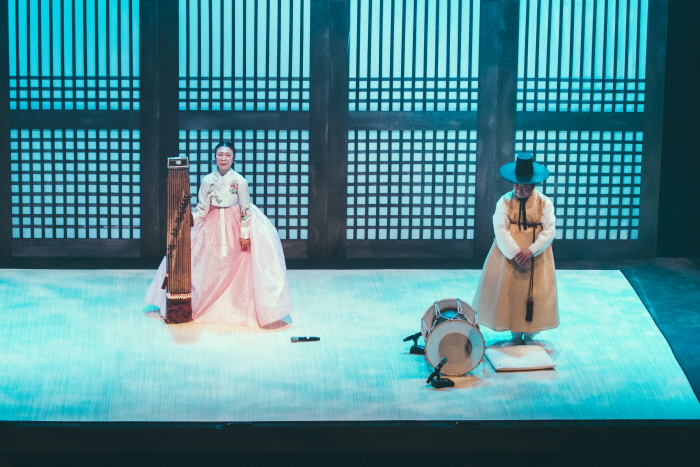
If you are interested in Korean traditional music, you probably heard of the musical instrument called gayageum. The gayageum is one of Korea’s iconic string instruments. It consists of 12 strings and a body made of the wood from a paulownia tree. The instrument ’s sorrowful yet graceful tone is capable of expressing the full range of human emotions.
Interestingly, the gayageum’s name originates from a country long lost in history. Around two millennia ago, the southeastern part of the Korean Peninsula was ruled by Gaya, a confederate of small polities. The country, which was famous for its ironwork, was taken over by Silla, a dynasty that later unified the Korean Peninsula. The records about the origin and makers of the gayageum are some of the few traces of Gaya that still exist today.
Gimhae, the host city of the 2020 Gimhae Gayageum Festival, is located in the former territory of Gaya. Each year, the city of Gimhae holds the Gimhae Culture Festival and the Gimhae Gayageum Festival to introduce the Gaya culture to the public and promote traditional Korean music or gugak. However, this year, the city was only able to hold the Gayageum Festival because of the COVID-19 pandemic.
The Healing Performance of Gayageum Masters
This year’s Gayageum Festival consisted of three parts: Masters, Virtuosos, and Masterpieces. On December 10, the festival opened with Masters, a special concert featuring gugak masters and their students. The concert began with a gayageum sanjo performed by Kang Jungyeol, an inheritor of Gayageum Sanjo and Byeongchang (Free-style Gayageum Solo Music and Singing), National Intangible Cultural Heritage No. 23. Later, Kang was joined by his students for a gayageum byeongchang version of “Sojinohwa” from Sugungga (Song of the Underwater Palace).
Sugungga is one of the five pieces of the pansori (epic chant), and it is based on Tokkijeon, or the “Tale of a Hare.” The story of Tokkijeon can be summarized as follows. The Dragon King of the Sea has fallen ill, and the court physician recommends the liver of a hare as a remedy. As such, the king sends a terrapin to the surface, who tricks the land animal into following him to the Dragon King’s court. Belatedly realizing that he has been tricked, the hare tries to escape his situation with a lie. He tells the Dragon King that he took out and washed his liver and placed it under a rock for safekeeping. Deceived by the hare, the Dragon King allows him to return to the surface, and the hare runs away as soon as he reached the shore.
After this performance, the concert moved onto a Sung Geumyeon–style gayageum sanjo performed by Master Ji Seongja, an inheritor of Jeollabuk-do Intangible Cultural Heritage No. 40. Then, the master brought her students onto the stage and sang “Saetaryeong (Bird Song)” with a gayageum accompaniment.
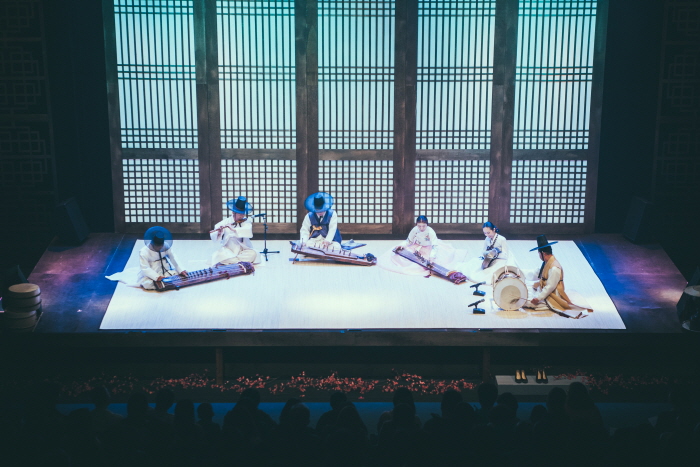
The concert wrapped up with an ensemble performance with the gayageum, daegeum (large-sized bamboo flute), ajaeng (seven- stringed zither), geomungo (six-stringed zither), janggu (hourglass-shaped drums), and jing (large gong). The free and upbeat improvisations of each instrument had audiences’ eyes and ears locked onto the stage.
The Musical Prowess of Young Gugak Virtuosos
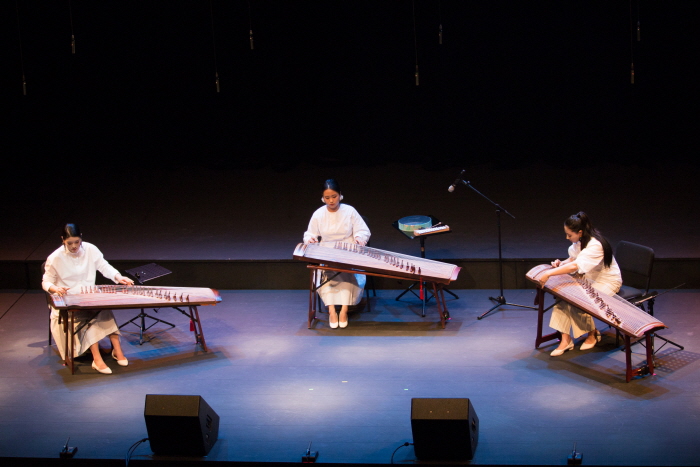
While the Masters concert featured deeply resonating performances by seasoned masters, the next part of the festival, Virtuosos, featured the performance of younger musicians. The concert opened with a gayageum byeongchang performed by a winner of the National Gayageum Competition held at the beginning of the festival. The next part of the concert was a performance by the gayageum ensemble Sagye. Sagye is a team of four female gayageum players who experiment with music that brings together the East and the West, and the past and the present.
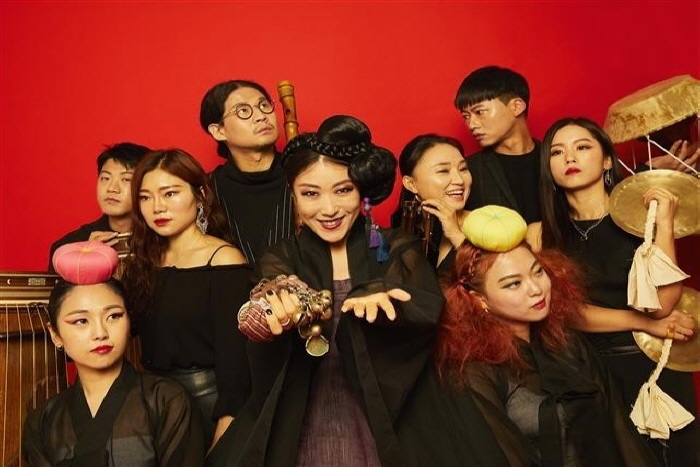
The collaboration between a handpan player and a gayageum ensemble also caught audiences’ attention with its genre-defying and boundary-breaking attempt. The clear and cheerful sound of the handpan went surprisingly well with the sound of the gayageum. Finally, the concert closed with the performance of the music group Akdan Gwangchil, who presented a contemporary reimagination of music and songs used in gut, a ritual rooted in Korean shamanism. The group caught the attention of the audience with the funky vibe of their music, which recently gained popularity after being featured in a video introducing Korea.
A Summation of Gayageum Masterpieces
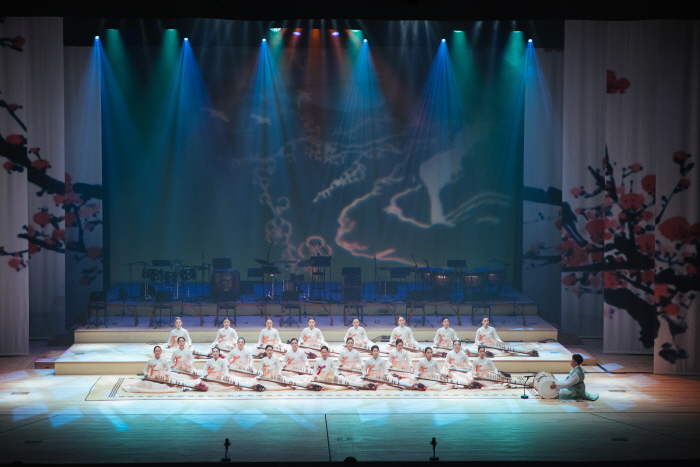
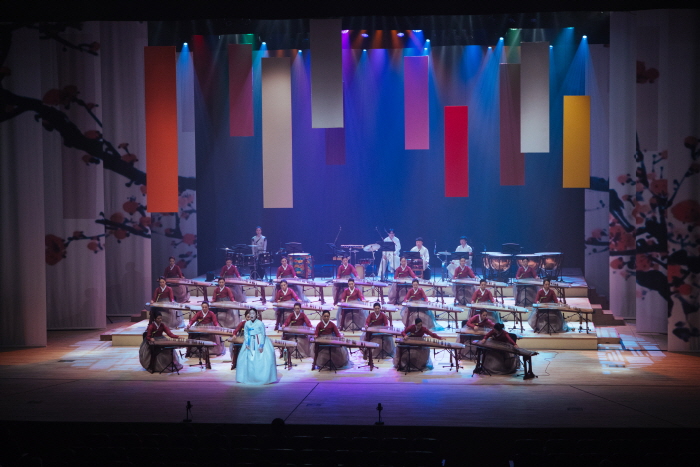
The last concert of the festival, Masterpieces, was as grand and astounding as its title suggests. Founded in 1998, the Gimhae Gayageum Orchestra is Korea’s only city orchestra specializing in the instrument. Its repertoire includes both traditional canons and more contemporary and daring musical attempts. In this concert, the group performed the gayageum byeongchang piece “Bangataryeong (Milling Song),” “A Legend of a Distant Future” for the 25-string gayageum, the cheolhyeongeum sanjo “Empathy” by Yoo Kyunghwa, and “A Gimhae Fantasy.”
The concert also featured guest performances, “Buk” and “Sarangga (Song of Love),” by the Korean traditional vocalist Ko Yeongyeol and “Sinmodeum” by a group led by Kim Duksoo, the samullori master and the holder of an Intangible Cultural Heritage title.
During the festival, various exhibitions and activities welcomed visitors at the lobby of the Gimhae Arts and Sports Center, including exhibitions of various string instruments, a photo zone, and Gayageum Experience, as well as programs for making key chains, gayageum plaster air fresheners, and mini gayageum. The programs were held with 20 preregistered participants each, and strict disease control measures were taken both before and after the programs.